
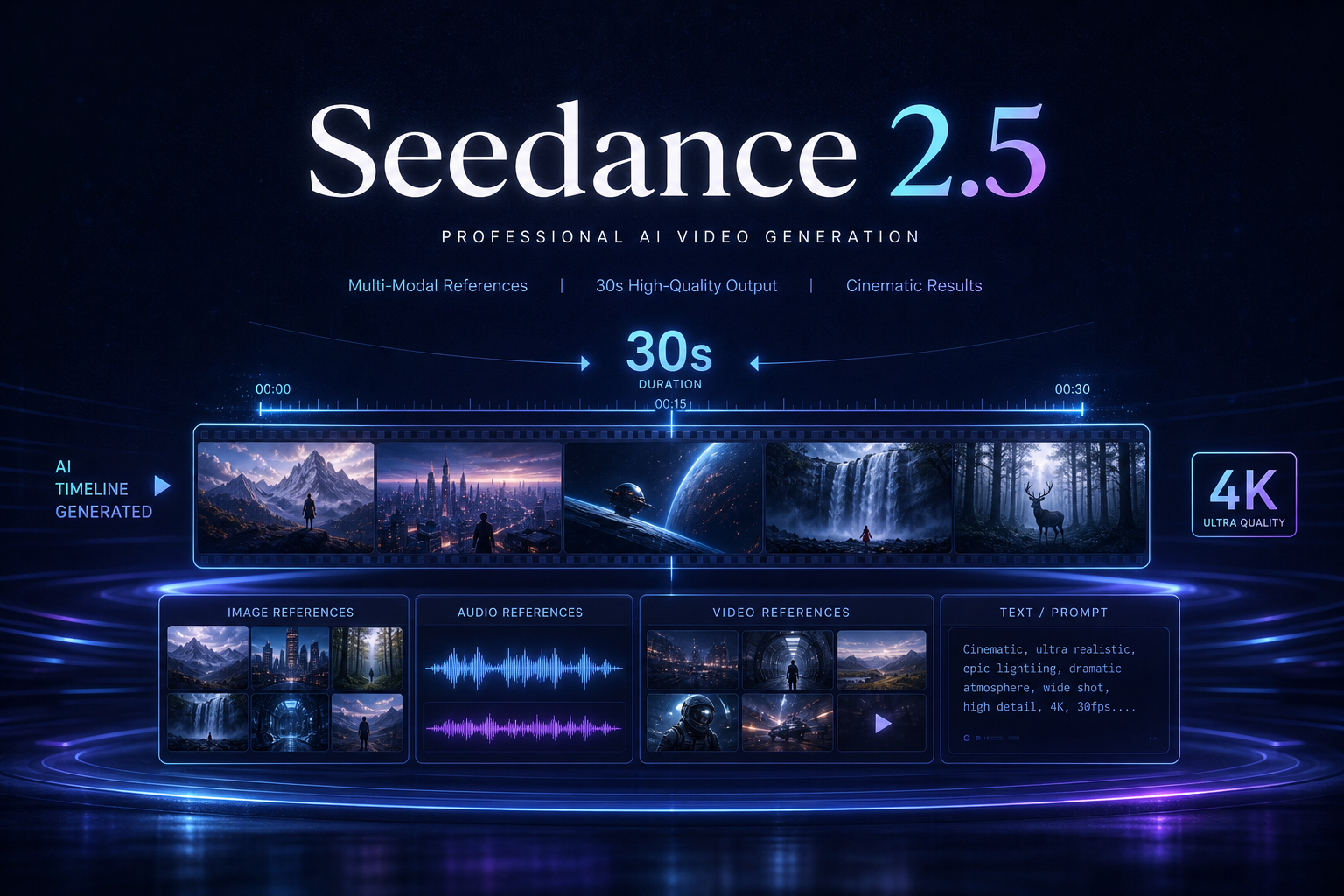
"Seedance vs Runway" is a high-frequency search pair among global creators. Runway is known for its Gen series and film/post-production ecosystem, with a tool matrix covering generation, editing, and collaboration; Seedance focuses more on director-style multimodal video generation — using reference assets and natural language to control composition, camera work, consistency, and native audio. This article compares by decision dimensions and links to clickable Seedance landing pages.
Seedance entry points: 2.0 · 2.5 · AI Video Generator. Also see Seedance vs Kling.
Product Positioning Differences
- Runway: Closer to an "AI film production suite" — generation is one part; editing, assets, and professional workflow narrative surround it
- Seedance: Closer to an "AI director output engine" — core focus is multimodal reference-driven joint audio-video generation and controllable deliverables
- Selection insight: Do you want a full post-production platform, or one highly controllable generation pipeline? The answer sets your priorities
Multimodal References & Director Control
Seedance treats "upload references + write director instructions" as a first-class capability: images lock character/product, video locks action/camera, audio locks rhythm/mood, text clarifies all five elements. This is especially critical for ad A/B testing and short-drama bible reproduction. Systematic methods: multimodal director guide and prompt engineering.
Runway also supports powerful generation and image/video conditioning, with high penetration among professional creators. If your team is deeply embedded in Runway pipelines, migration cost is a real constraint; if you are building "reference-driven output" from zero, Seedance's product narrative is more vertical with a shorter learning path — start from the getting started tutorial.
Native Audio-Video: An Underrated Delivery Difference
Many comparisons only discuss visuals and ignore sound. Seedance emphasizes model-level audio-video binding, suited for feed ads and product demos that need "reviewable audio in the clip." Runway users often refine audio in its editing ecosystem after generation — not necessarily worse, but it means more steps and tool switching. If your KPI is "an audio-video draft ready for review within 60 seconds," prioritize testing Seedance.
Team, Cost & Generation Choice
- Individuals / small teams controlling cost: Evaluate Seedance 2.0 Mini and Fast
- Brand half-minute narrative / high-spec delivery: Evaluate Seedance 2.5
- Studios with existing Runway seats: Introduce Seedance in parallel for a "reference consistency specialty" rather than a one-shot replacement
- Industry scenarios: E-commerce, advertising, short drama — see the industry applications guide
When to Choose Seedance? When to Stay on Runway?
- Choose Seedance: Need multimodal references to lock subjects, want native audio-video drafts, prefer director prompts for fast iteration
- Stay on / also use Runway: Team workflow is bound to its editing and collaboration capabilities, or clients specify that toolchain
- Use both: Runway for some shots and editing; Seedance for core shots with character consistency and audio preview
- Still undecided: Open the Seedance 2.0 topic hub, fill gaps via the article matrix, then test
Conclusion
Seedance vs Runway is not simply "who scores higher" — it is a choice between a vertical director engine and a comprehensive film AI suite. If your next step is deliverable multimodal audio-video shorts, start testing from Seedance 2.0; if you are still comparing domestic motion models, continue with Seedance vs Kling.